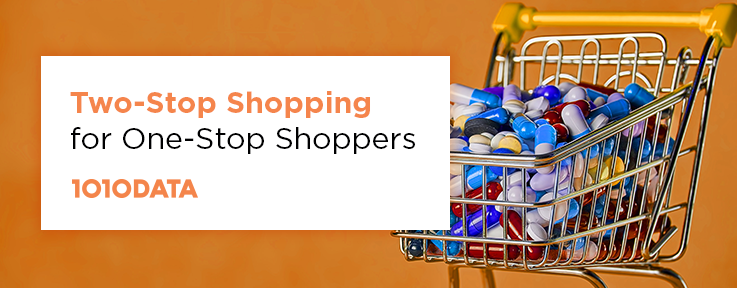
Not long ago, shoppers would primarily travel to grocery stores to pick up their groceries, and to drug stores to pick up their prescriptions.However, the retail landscape has drastically evolved to meet the consumer need for a “one-stop” shop experience. It’s now common for consumers to fill their prescriptions at the grocery store and pick up groceries at the pharmacy.
As grocers and retail pharmacies are pressured to address this trend, both have expanded their competitive set beyond their established industries. Grocers are now concerned with losing sales to drug stores and vice versa. To combat this loss, some of the largest players in the space are taking a creative approach. Kroger recently announced that it will be selling over 2,300 Kroger-branded products at Walgreens locations. The announcement of the nation’s largest retail pharmacy and largest grocer teaming has left many unanswered questions.
Aside from wondering how these companies will share profits, we’re left pondering if this partnership makes the most sense. Sure, both have the largest nationwide footprint in their respective areas, but does that mean there aren’t other players with which they could have teamed up?
When analyzing the percent of regular customers at top grocery chains, defined as customers that shopped at least 52x in a year that also shop at the leading retail pharmacies, the results reveal that Kroger and Walgreens have highly-overlapping customer bases. 79% of regular Kroger shoppers also shop at Walgreens, so why wouldn’t Kroger want to capture some of those sales at Walgreens locations? This could also benefit Walgreens if it draws loyal Kroger shoppers into stores who then end up also purchasing non-Kroger branded items. Kroger has the most customer overlap with Walgreens compared to CVS and Rite Aid, which might explain why Walgreens over others.
On the other hand, when considering the cross shopping habits of other grocer’s customers, the data reveals that Publix and H-E-B are also good matches for Walgreens. 86% of both Publix and H-E-B’s regular shoppers also shop at Walgreens. The partnership between Kroger and Walgreens is currently being explored in Kentucky, but it could be a good move for Publix to explore this in Florida and H-E-B to test out in Texas with Walgreens. It also appears that Ahold, owner of Stop & Shop and Giant, could benefit from a similar partnership with CVS.

Reviewing this data, you may think, so what? A majority of regular Kroger shoppers pop into a Walgreens once in a while. If you narrow down the population and compare the percent of regular Kroger shoppers who make a purchase at a Walgreens on the same day they go to Kroger, the data shows that it actually is a big deal. 5% of regular Kroger shoppers will make a same-day purchase at Walgreens. Kroger’s decision to put their products in Walgreens is a strategic move to make up for this 5%, because now if the shopper goes into a Walgreens on the same day, they may end up purchasing Kroger products over Walgreens branded items. For Publix and H-E-B, the rate of same day cross-shoppers with Kroger is 6% and 7%, respectively. If those grocers are looking to close the gap, exploring an option similar to Kroger could help.

The Kroger-Walgreens partnership is still in the pilot phase, but if it pays off, Kroger will have the first-mover advantage, potentially ruining any further partnerships that Publix or H-E-B could take with the retail pharmacy giant. Either way, the data shows that despite best efforts to create one-stop shop experiences, consumers will still go to the grocery store and the pharmacy in the same day. However, as this pilot progresses, our data may see less cross-shopping between Kroger and Walgreens, especially on the same day.
To analyze more cross-shopping patterns and how consumer preferences have shifted market dynamics within grocery and pharmacy, please reach out to us at insights@1010data.com.


Recent Comments